
Overview
Affiliate Performance shows which TikTok creators drive affiliate orders and how those orders contribute to profit. Brands can review one active shop. Agency accounts can compare creators across connected clients and shops without converting or mixing currencies.
The page is available to eligible Growing and Agency plans for connected US shops after the shop grants Dashboardly the TikTok seller.affiliate_collaboration.read permission. TikTok does not currently expose this Affiliate Seller API permission to Dashboardly for non-US shops, so the Affiliates navigation item is hidden for those shops.
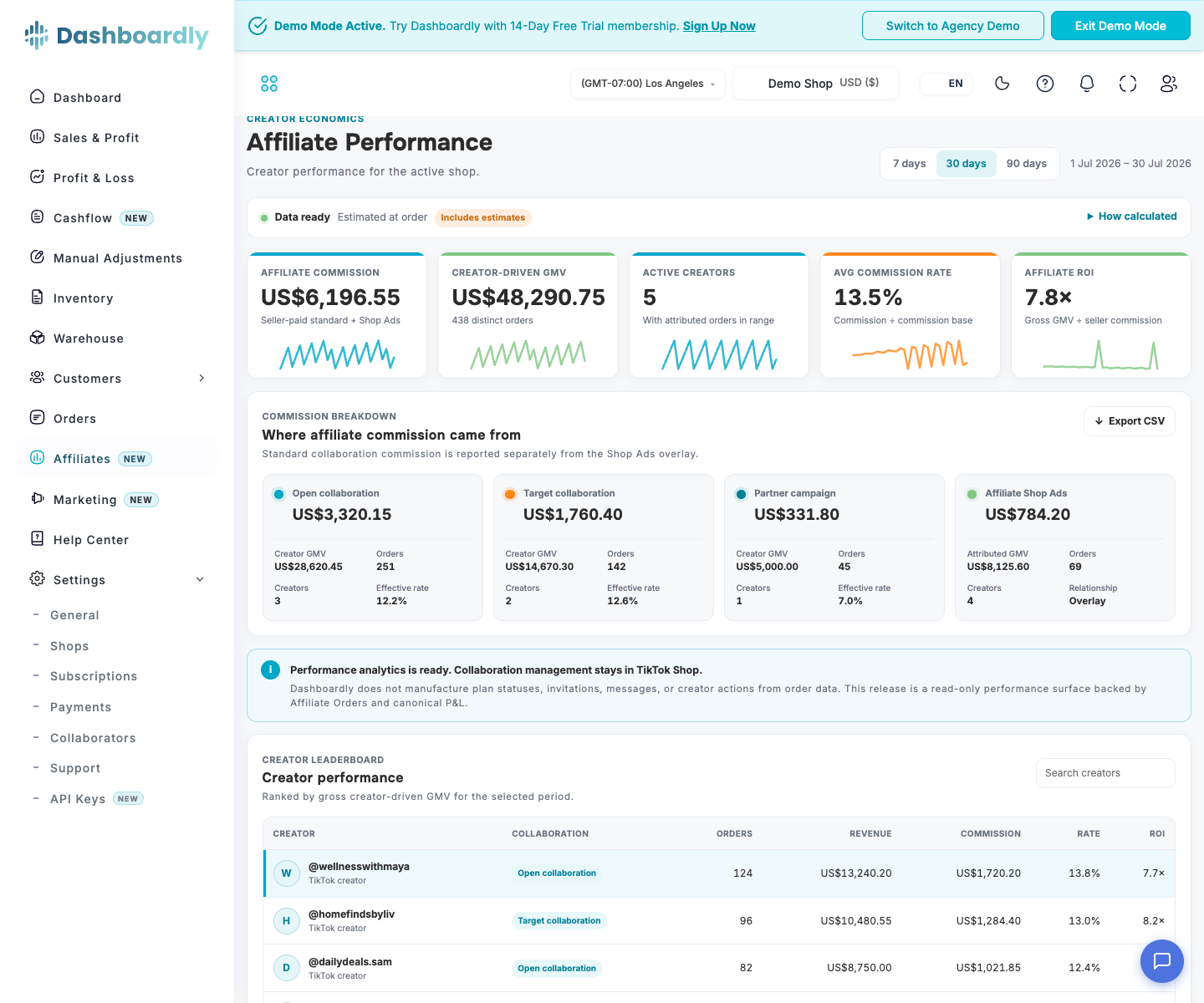
Preview in Demo Mode
Affiliate Performance is populated in both Dashboardly demo experiences. The brand demo shows one US shop, and the agency demo shows a cross-client roll-up for its active US shops. The agency demo's UK shop remains available elsewhere in Demo Mode but is excluded from this US-only page.
Demo creator, content, product, GMV, commission, and GMV Max creative rows are realistic synthetic data matched to the demo's canonical orders and P&L facts. The creative rows let you explore spend, paid traffic, blended revenue, ROAS, ACoS, CTR, and CPC in the creator detail view. They are not imported from a real TikTok account, and Demo Mode never creates fake OAuth tokens or grants the seller.affiliate_collaboration.read permission. Reconnection actions remain protected in Demo Mode.
Choose a Period
Use the period control to view the last 7, 30, or 90 days, or choose Custom for any inclusive range of up to 90 calendar days. Dashboardly applies that one range to the Affiliate Orders facts and the canonical P&L allocation. When you change the period, the current results remain visible with an Updating state until the new range is ready; choosing another period replaces the pending request.
Each currency has a separate roll-up. Dashboardly does not apply an implicit foreign-exchange conversion.
Read the Performance Overview
The five summary cards lead with Creator-driven GMV, followed by Affiliate commission, Avg commission rate, Affiliate ROI, and Estimated net profit. The GMV card also shows the active creator and order counts. Each trend line uses the daily Affiliate Orders in your selected period; it is not sample data or a forecast.
The Commission breakdown separates Open collaborations, Target collaborations, partner campaigns, and the Shop Ads overlay. Standard collaboration cards show GMV, distinct orders, active creators, and the effective rate for that collaboration type. Shop Ads can overlap a standard collaboration order, so Dashboardly shows it as an overlay instead of adding its order count to the standard collaboration counts.
Effective commission rate = seller-paid commission ÷ TikTok commission base
Affiliate ROI = gross creator-driven GMV ÷ seller-paid affiliate commission
For example, if creators generate 20,000 in gross GMV and the normalized seller-paid commission is 2,000, Affiliate ROI is 10.0×. Use the labelled commission basis and estimated-data badge when comparing that value with TikTok Shop.
Analyze Creators, Content, and Products
The Creator performance leaderboard can rank creators by creator-driven GMV, estimated net profit, estimated net margin, Affiliate ROI, or Affiliate commission. Choose 10, 20, or 30 creators per page and use the numbered pagination controls to move through the result. Select a creator to open a dedicated detail window with their GMV, commission, average commission rate, Affiliate ROI, estimated profit and margin, distinct video count, shipped/delivered sample milestones, products, and TikTok content for the period. Search filters the current shop's creator list without changing the selected dates.
Product names in creator details and Top products via affiliates open that product's Dashboardly Product Overview when TikTok returned a canonical product ID. A SKU-only grouping stays readable but is not turned into a dead product link. For video content, Dashboardly shows the complete TikTok content ID and links VIDEO to the creator's public TikTok video when TikTok returned both a valid creator username and video ID. Dashboardly does not invent a link for LIVE content or incomplete identifiers.
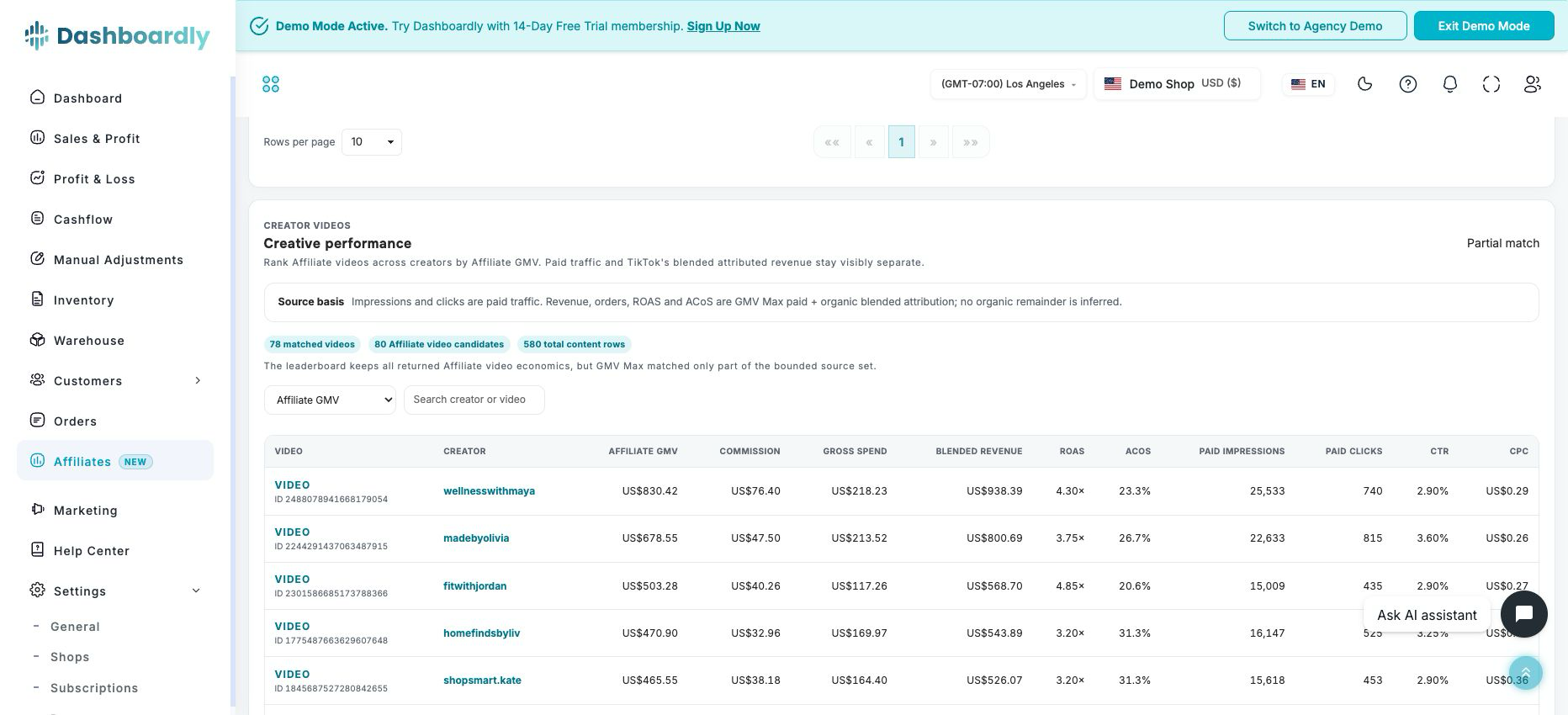
When the same video ID exists in imported GMV Max creative data, the detail window also shows gross and net spend, ad credits, TikTok-attributed blended revenue and orders, ROAS, ACoS, cost per order, paid impressions, paid clicks, CTR, CPC, and CPM. When TikTok supplies stable video metadata, Dashboardly also shows the source caption beside the full content ID, so you can recognize and search a creative without opening every video. Unmatched videos stay visible with their Affiliate facts and blank advertising metrics instead of being dropped.
Sample orders and Shipped samples are different. TikTok marks an order as a sample independently of fulfillment. Dashboardly labels a creator sample as shipped only when TikTok supplies a ready-to-ship timestamp, tracking, or a shipped/later status; delivery requires TikTok's delivery timestamp or delivered/completed status. If the source counts do not reconcile, shipment milestones stay unavailable instead of treating every requested sample as sent. Estimated net profit already follows canonical P&L and its sample-cost setting, so the creator view does not add sample cost a second time.
The shop-level Creative performance leaderboard compares the returned Affiliate videos across creators without opening each creator separately. Search by creator, video ID, or an imported TikTok caption; rank by Affiliate GMV, Affiliate commission, gross ad spend, blended attributed revenue, ROAS, ACoS, or paid CTR; and open the public TikTok video or its creator detail window from the same row. The table keeps unmatched Affiliate videos instead of silently filtering them out. Dashboardly bounds this secondary analysis to 240 returned video candidates and marks the result partial when the Affiliate source contains more content than the bounded presentation set.
An imported caption is TikTok's source text, not a speech transcript or a Dashboardly-generated hook analysis. Dashboardly does not save TikTok's temporary preview, cover, or profile-image links as durable creative data. A future transcript or script-analysis feature requires a separate approved media-processing and privacy contract, so the current page never presents a caption as verified spoken wording.
TikTok defines those sources differently:
- GMV Max impressions and clicks are paid traffic.
- GMV Max revenue, orders, ROAS, and ACoS use TikTok's paid + organic blended attribution. Dashboardly does not relabel them as paid-only revenue.
- Shop Ads GMV is the exact Affiliate-order overlay where TikTok reported seller-paid Shop Ads commission.
- Other Affiliate GMV is the remaining Affiliate GMV. It can contain organic and other attribution, so it is not labelled organic GMV.
This distinction prevents a blended TikTok attribution total from being presented as an exact paid-versus-organic sales split. GMV Max uses a 24-hour attribution window, and net spend can update up to 11 hours later.
TikTok's Affiliate Orders response does not include a creator profile-image URL, so the creator marker uses their initial. Adding real creator avatars would require a separate approved TikTok creator profile data source and permission.
The Performance signals section highlights deterministic observations from the current period, including the leading creator, creator concentration, and the lowest available estimated margin. These are explanations of the current data, not automated recommendations or actions.
The Product × creator heatmap shows which creator-product combinations generated the most gross GMV. The Top products via affiliates section combines GMV, creator reach, orders, units, and seller-paid commission for each product. Export CSV downloads all creator rows for the selected shop and period, not only the currently visible pagination page. In agency mode, the export contains the complete cross-client creator roll-up for the selected period.
Manage Collaborations in TikTok Shop
Affiliate Performance is a read-only analytics page. Create or edit collaboration plans, invite creators, send messages, and manage samples in TikTok Shop. Dashboardly does not infer invitation status, plan status, or creator actions from Affiliate Order records, so unsupported management controls are not shown as if they were available.
Metrics
Affiliate GMV
Gross merchandise value is the TikTok SKU price multiplied by ordered quantity, counted once per affiliate order/SKU line. It is shown before returns and refunds and is not the margin denominator.
Commission Base
TikTok supplies two possible bases:
- Estimated at order: ordered sale price and quantity before final return outcomes.
- Actual after returns: TikTok's actual post-return commission base after finality.
Dashboardly uses one labelled basis for the whole shop and period. It never silently adds estimated and actual bases into one unlabeled total. An agency roll-up can show Mixed by shop when complete shops use different labelled bases.
Affiliate Commission
Creator, partner-campaign, and Shop Ads commissions come from TikTok Search Seller Affiliate Orders. Dashboardly normalizes creator and partner-campaign commission into one standard affiliate-commission total and also shows the partner component separately for disclosure. That disclosure is not added again. TikTok/co-funded creator and partner bonuses are not treated as seller cost unless a seller-ledger field proves the seller-funded share.
Estimated Net Profit and Margin
Dashboardly matches affiliate order/SKU facts to canonical P&L facts, then proportionally allocates canonical net profit and net sales to each creator.
Estimated net margin = allocated canonical P&L net profit ÷ allocated canonical P&L net sales
Shop, creator, and currency roll-ups divide summed allocated profit by summed allocated net sales. They never average percentages and never use gross Affiliate GMV as the denominator.
Open How calculated to see count-only allocation coverage: how many Affiliate order/SKU facts and distinct orders have canonical P&L weights. These diagnostics never expose order, creator, SKU, product, or content identifiers. If even one valid Affiliate fact lacks a canonical weight, the coverage is partial and estimated net profit, net sales, and margin remain unavailable for the whole range.
Canonical P&L Affiliate-attributed sales is a separate metric. When the canonical P&L range is ready, Dashboardly distributes that total across creators by the Affiliate API commission base, so it can remain available when the order/SKU weights required for estimated margin are incomplete. If canonical P&L is still processing or temporarily unavailable, Affiliate GMV and commission remain visible from the validated Affiliate source while Affiliate-attributed sales and every estimated P&L field stay unavailable. It is not Affiliate GMV or the TikTok commission base.
Affiliate commission base and Affiliate API commission amounts are not expected to equal P&L Affiliate Sales or finance-ledger commissions. These sources use different discount, return, and settlement bases. Dashboardly keeps them clearly labelled instead of blocking valid creator data on a false one-to-one comparison.
Data Statuses
- Data ready: scope, region, import coverage, currency, creator identity, commission basis, and internal creator-to-shop totals are complete. Affiliate GMV and commission can be ready even when a valid Affiliate order has no canonical P&L match; in that case estimated net profit, net sales, and margin remain unavailable instead of using a partial or zero weight.
- Partial allocation coverage: count-only diagnostics identify unmatched Affiliate facts and orders. Source-domain Affiliate GMV and commission stay available without waiting for a slower canonical P&L calculation, while Affiliate-attributed sales and every estimated P&L allocation remain unavailable until their canonical data is ready.
- Includes estimates: at least one Affiliate API or canonical P&L value has not reached final settlement.
- Partial data: one or more shops are excluded from agency roll-ups. Missing values are never presented as zero.
- No creator orders: the import is complete for the period but no creator-attributed orders exist.
Dashboardly fails closed when a range has incomplete lower history, stale upper coverage, mixed currency within one shop, duplicate identities, non-conserving Affiliate totals, or a malformed commission base. An unresolved canonical order/SKU match disables only the separate estimated P&L allocation for the whole range; Dashboardly does not discard otherwise valid Affiliate API GMV or commission and does not manufacture a canonical weight.
Dashboardly continues to show the most recent completed and fully covered Affiliate snapshot while the next automatic sync is running. A first-time import or a requested period that is not yet covered remains unavailable, so an in-progress sync never presents partial history as complete.
Grant the Permission to an Older Shop
US shops connected before Dashboardly received the Affiliate permission may need to authorize again. Affiliate Performance shows two recovery choices without presenting missing data as zero:
- Reconnect now: the Dashboardly account owner can open TikTok authorization immediately and approve the new permission. Only the account owner can use this action because reconnecting must remain bound to the existing merchant and shop.
- Send invite to owner: an authorized Dashboardly user can email the shop owner a secure reauthorization link. The recipient approves the permission in TikTok; the link cannot be used to reconnect a different merchant or shop. Dashboardly limits repeated delivery so the owner is not spammed.
Existing Dashboardly data and settings remain intact. After successful authorization, up to 90 days of recent Affiliate history imports in the background. A period remains unavailable until its lower and upper coverage are complete.
Affiliate Performance is currently US-only. The navigation item and route are unavailable for non-US shops rather than showing an unsupported or misleading zero-data page.
Troubleshooting
The page asks me to reconnect the shop. The shop's current authorization does not include the Affiliate collaboration read permission. If you own the Dashboardly account, choose Reconnect now. Otherwise choose Send invite to owner so the owner can approve the new TikTok permission.
Why don't I see Affiliates in the menu? The current TikTok Affiliate Seller API integration is available to US shops only. Dashboardly hides the item when the active shop is outside the US. For agency accounts, the Affiliate Performance report appears when the connected client portfolio contains at least one eligible US shop.
A longer period is unavailable but 30 or 90 days works. The recent recurring import is ready, but older history has not finished backfilling. Use a covered period or wait for the historical import to complete.
Affiliate Center and P&L show different commission totals. Check the period, the Estimated at order or Actual after returns badge, and settlement timing. Affiliate Performance reports creator payout facts; P&L reports signed finance-ledger cost. They are related but not identical accounting views.
Why is a creator missing? Dashboardly does not create an "Unattributed" placeholder when TikTok creator identity or order/SKU evidence is incomplete. The affected shop or period stays visibly unavailable until the import can prove the attribution.
Can Dashboardly show exact paid and organic revenue for each creator video? Not from the current TikTok Shop and GMV Max source contracts. Dashboardly shows exact paid impressions and clicks, exact Affiliate Shop Ads commission disclosure, and TikTok's blended GMV Max revenue separately. It never calculates “organic revenue” by subtracting one differently attributed source from another. Use the source labels in Creator economics and Creative performance when diagnosing attribution.
Why can an external TikTok Pixel report more purchases than the store? Pixel and Events API reporting uses attribution and event matching rather than the store's transaction ledger. Duplicate browser/server events must share the same event ID, and click identity must be carried consistently for reliable matching. Affiliate Performance remains based on TikTok Shop Affiliate orders and does not treat an external Pixel purchase count as order truth. Compare Pixel configuration and event IDs against Shopify or another commerce ledger before changing campaign decisions.